
 AUS (+61) 8 6610 2010
 UK (+44) 7782 222732
 USA (+1) 844 624 1859
 CA (+1) 844 624 1859
 IN (+91) 9013504886
Experience Top-Rated Tutoring – 4.3/5
★★★★★ by Parents & Students

Book a free trial session and start your personalized learning journey with our expert tutors.
Fill out the form below and one of our experts will contact you shortly
Everything You Need, All in One Place
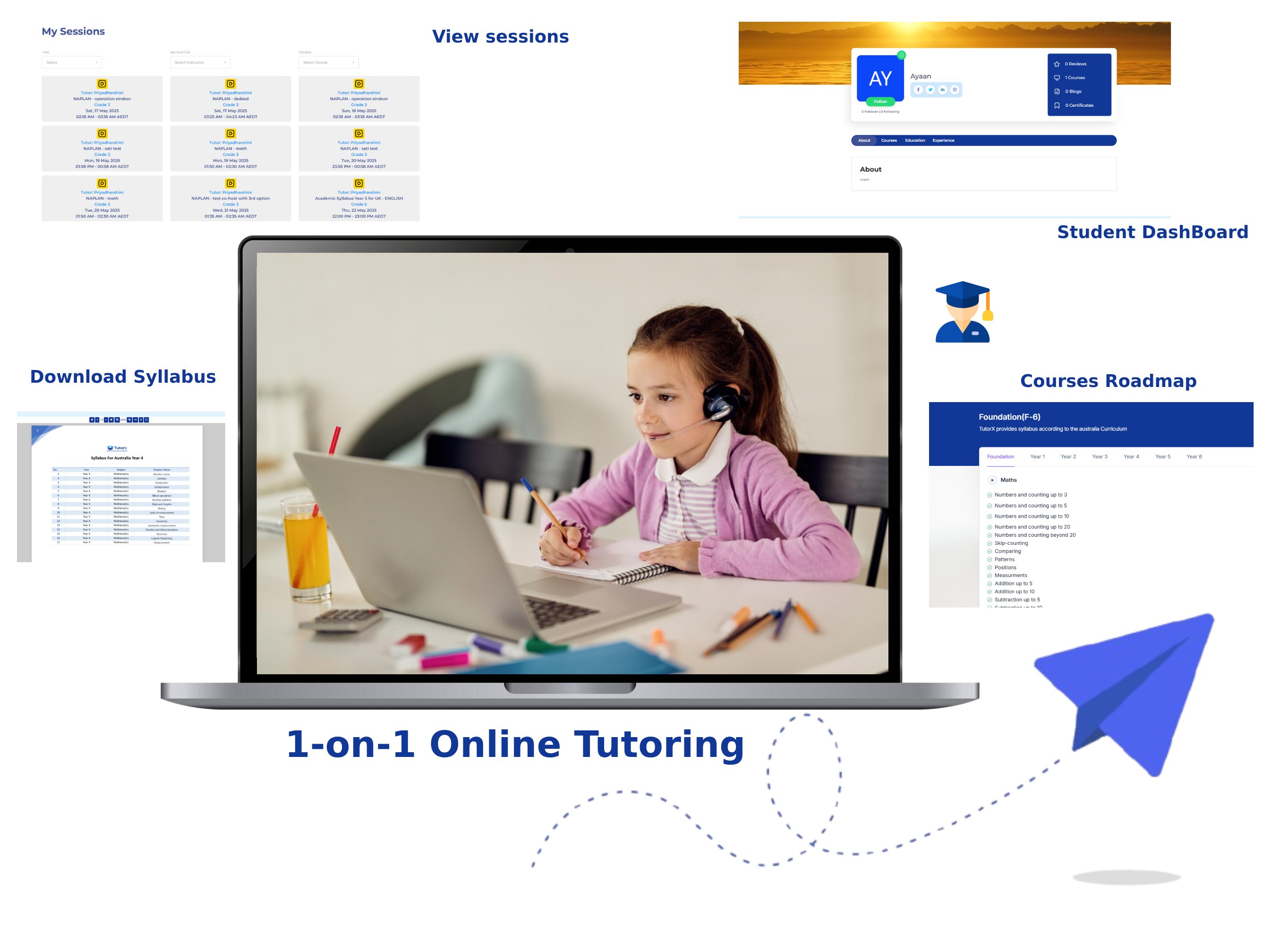
At The TutorX, we believe learning should be clear, focused, and at your fingertips. That’s why we’ve built a smart and user-friendly dashboard to empower every student on their academic journey. From live sessions and homework to performance tracking and resources—everything is seamlessly integrated to help you stay ahead with confidence.
The NCLEX-RN (National Council Licensure Examination for Registered Nurses) is a standardized exam required for nursing licensure in the United States and Canada. It is designed to evaluate whether a nursing graduate possesses the knowledge, skills, and clinical judgment necessary to provide safe, effective entry-level nursing care. The exam uses a computer-adaptive testing (CAT) format, meaning the difficulty of questions adjusts based on your performance. The NCLEX-RN covers four major Client Needs categories — Safe and Effective Care Environment, Health Promotion and Maintenance, Psychosocial Integrity, and Physiological Integrity — and incorporates Next Generation NCLEX (NGN) items including case studies that measure clinical judgment.
.png1751287272.png)
You should take the NCLEX-RN if you have completed an accredited nursing program (associate degree, diploma, or bachelor's degree in nursing) and are seeking licensure as a Registered Nurse in the United States or Canada. The exam is a mandatory step in the licensing process and is required by every state board of nursing before you can legally practice as an RN. It is essential for anyone pursuing a career in clinical nursing, hospital care, community health, critical care, pediatrics, maternity, mental health, or any other nursing specialty. The NCLEX serves as a reliable measure of your ability to apply clinical judgment, prioritize patient safety, and deliver competent nursing care from day one on the job.

| Category / Subcategory | % of Exam | Description |
|---|---|---|
| Management of Care | 15–21% | Covers nursing leadership, delegation, ethical and legal practice, client advocacy, collaboration with the interdisciplinary team, and care coordination. |
| Safety and Infection Prevention and Control | 10–16% | Focuses on maintaining a safe environment, implementing infection control measures, handling hazardous materials, and using proper ergonomics and safety devices. |
| Health Promotion and Maintenance | 6–12% | Addresses growth and development, disease prevention, health screening, self-care education, and lifestyle choices across the lifespan. |
| Psychosocial Integrity | 6–12% | Tests your ability to provide care related to mental health, coping mechanisms, grief and loss, crisis intervention, abuse and neglect, and substance misuse. |
| Basic Care and Comfort | 6–12% | Covers nutrition, hydration, rest, sleep, mobility, personal hygiene, elimination, and non-pharmacological pain management interventions. |
| Pharmacological and Parenteral Therapies | 13–19% | Focuses on medication administration, IV therapy, blood products, expected and adverse effects, dosage calculations, and client education on medications. |
| Reduction of Risk Potential | 9–15% | Addresses diagnostic tests, lab values, potential complications, monitoring devices, and therapeutic procedures to minimize client risk. |
| Physiological Adaptation | 11–17% | Covers care for clients with acute, chronic, or life-threatening conditions including fluid and electrolyte imbalances, hemodynamic changes, and medical emergencies. |
This major category is divided into two subcategories — Management of Care and Safety and Infection Prevention and Control — and together they make up approximately 25–37% of the exam. Management of Care questions assess your ability to lead and coordinate nursing care, delegate tasks appropriately, advocate for clients, apply ethical and legal principles, and work within an interdisciplinary team. Safety and Infection Prevention and Control questions test your knowledge of standard and transmission-based precautions, proper hand hygiene, use of personal protective equipment (PPE), safe medication administration, fall prevention, and emergency preparedness.
Making up 6–12% of the exam, this category evaluates your understanding of how to promote health and prevent disease across all age groups. You will encounter questions on prenatal and newborn care, growth and development milestones, aging processes, immunization schedules, health screening recommendations, and client education on lifestyle modifications. Success in this section requires a strong foundation in developmental theories, preventive health strategies, and the ability to identify risk factors that can be reduced through early intervention and patient teaching.
Representing 6–12% of the exam, Psychosocial Integrity questions assess your ability to provide emotional, mental, and social support to clients and their families. Topics include therapeutic communication techniques, crisis intervention, recognizing signs of abuse or neglect, supporting clients through grief and loss, caring for clients with mental health disorders, understanding the effects of substance misuse, and implementing appropriate coping strategies. You will also be expected to recognize cultural and spiritual influences on health and to provide care that respects each client's unique psychosocial needs.
This is the largest category on the NCLEX-RN, accounting for approximately 38–62% of the exam, and is divided into four subcategories: Basic Care and Comfort, Pharmacological and Parenteral Therapies, Reduction of Risk Potential, and Physiological Adaptation. Questions in this category test your clinical knowledge across a wide range of topics — from nutrition and mobility to complex medication management, lab value interpretation, and caring for clients with acute or life-threatening conditions. Expect questions on IV therapy, blood transfusions, perioperative care, fluid and electrolyte imbalances, and responding to medical emergencies.
The NCLEX-RN is a computer-adaptive test (CAT) administered at Pearson VUE testing centers. The exam length ranges from 75 to 145 questions, and you are given a maximum of 5 hours to complete it (including breaks). The CAT format means the computer selects each question based on how you answered the previous one — if you answer correctly, the next question becomes more difficult, and vice versa. Question types include traditional multiple-choice, select-all-that-apply (SATA), ordered response (drag-and-drop), fill-in-the-blank calculations, hot-spot items, and Next Generation NCLEX (NGN) case studies that measure clinical judgment using the NCSBN Clinical Judgment Measurement Model.
Unlike traditional exams, the NCLEX does not provide a numerical score or percentage. It is a pass/fail exam. The computer continuously evaluates whether your ability level is above or below the passing standard as you answer each question. The exam ends when the computer has determined with 95% confidence that you are clearly above or below the passing standard, when you have answered the maximum number of questions (145), or when you run out of time. The passing standard is set by the NCSBN Board of Directors every three years and is based on the minimum level of ability required for safe, effective entry-level nursing practice.
Since the NCLEX is a pass/fail exam, there is no "score" in the traditional sense. You either meet the passing standard or you do not. Many candidates worry about the number of questions they receive — finishing at the minimum 75 questions does not necessarily mean you failed, nor does receiving the maximum 145 questions mean you did poorly. The CAT algorithm simply needs enough data to make a reliable decision about your competence. What matters is the consistency of your performance against the passing standard, not the total number of questions answered.
If you do not pass the NCLEX on your first attempt, you are allowed to retake the exam. However, there is a mandatory 45-day waiting period between attempts. The specific rules regarding the maximum number of attempts and any additional requirements vary by state board of nursing — some states allow unlimited retakes while others may impose a limit (commonly up to eight attempts per year). Before retaking the exam, it is strongly recommended that you review your Candidate Performance Report (CPR), which breaks down your performance in each Client Needs category. This report helps you identify your weak areas so you can focus your preparation more effectively. Keep in mind that each retake requires a new registration with Pearson VUE and payment of the examination fee. Many candidates benefit from enrolling in an NCLEX review course or working with a tutor between attempts to strengthen their understanding of the material and improve their test-taking strategies.
Administrator

Lorem Ipsum is simply dummy text of the printing and typesetting industry. Lorem Ipsum has been the industry's standard dummy text ever since the 1500s, when an unknown printer took a galley of type and scrambled it to make a type specimen book.
Lorem Ipsum is simply dummy text of the printing and typesetting industry. Lorem Ipsum has been the industry's standard dummy text ever since the 1500s, when an unknown printer took a galley of type and scrambled it to make a type specimen book. It has survived not only five centuries, but also the leap into electronic typesetting, remaining essentially unchanged. It was popularised in the 1960s with the release of Letraset sheets containing Lorem Ipsum passages, and more recently with desktop publishing software like Aldus PageMaker including versions of Lorem Ipsum.
Reach out to us for inquiries, support, or more information about our personalized tutoring services
We are happy to hear from you. You can either fill out the form or send us an email.
A1, 220, 4th Floor, Sushant Lok Phase 2, Sector 55, Gurugram, Haryana – 122011, India
info@thetutorx.com
