
 AUS (+61) 8 6610 2010
 UK (+44) 7782 222732
 USA (+1) 844 624 1859
 CA (+1) 844 624 1859
 IN (+91) 9013504886
Experience Top-Rated Tutoring – 4.3/5
★★★★★ by Parents & Students

Book a free trial session and start your personalized learning journey with our expert tutors.
View BrochureFill out the form below and one of our experts will contact you shortly
TutorX empowers students with powerful mental math and abacus techniques for faster, sharper calculations.
Students master addition, subtraction, multiplication & division using both Abacus beads and Vedic sutras for double confidence.
.png1747731424.png)
Combining Abacus visualization with Vedic Maths tricks trains the brain to calculate rapidly without calculators or devices.
Students learn to visualize numbers on the Abacus while applying Vedic shortcuts for squares, roots & more — making tough sums easy.
Abacus practice builds number sense, while Vedic Maths gives flexible approaches to tackle large calculations creatively.

Regular mental calculations sharpen memory, boost focus, and enhance cognitive skills for academics and competitive exams.

Combined training helps students solve complex problems faster and with higher accuracy, giving them a clear edge in math skills.
The world's oldest calculating device — a frame of rods and beads that trains both arithmetic skill and mental visualisation.
The Abacus is a manual calculation frame consisting of rods with sliding beads, used for over 5,000 years. The modern standard is the Japanese Soroban — one upper bead (value 5) and four lower beads (value 1 each) per column, each column representing a place value.
Students internalise a precise mental image of bead positions — called Anzan — enabling complex arithmetic entirely in the head, activating both the logical left brain and the visual-spatial right brain simultaneously.
Simultaneously engages left-brain logic and right-brain spatial visualisation for balanced cognitive development.
Advanced students solve 5-digit additions in under 2 seconds through the Anzan technique.
Tracking bead positions builds sustained attention spans of 30–45 minutes from age 5.
Builds deep intuition for place value, regrouping, and magnitude estimation.
Holding bead images during calculation directly expands short-term and working memory capacity.
Consistent improvement in mathematics and science scores across all age groups.
| Component | Description | Value |
|---|---|---|
| Frame | Outer wooden or plastic border | — |
| Reckoning Bar (Beam) | Horizontal divider separating upper and lower bead sections | — |
| Rods / Columns | Vertical wires — each represents one place value, ×10 per rod right to left | ×10 per rod |
| Upper Bead (Heaven) | One bead above the beam per rod. Active when pushed down to the beam. | = 5 |
| Lower Beads (Earth) | Four beads below the beam per rod. Active when pushed up to the beam. | = 1 each |
| Dot Markers | Small dots marking units, thousands, and millions columns | — |
Six structured chapters from foundational concepts to advanced mental arithmetic.
Understand the origin, structure, and components of the abacus before performing any operations.
Learn bead-based addition from direct moves to the complementary friend formulas for carrying.
Apply the friend formulas in reverse for subtraction, including borrowing across columns.
Transition from repeated addition to the shift-and-multiply technique for multi-digit multiplication.
Understand the quotient-placement method and long division using the abacus frame.
Perform all calculations through pure mental visualisation of bead positions — no physical tool required.
An ancient Indian system of 16 sutras enabling rapid mental calculation across arithmetic, algebra, geometry, and beyond.
Vedic Mathematics is a coherent system of mental calculation derived from the ancient Indian Vedic scriptures, specifically the Atharva Veda. Documented by Sri Bharati Krishna Tirthaji (1884–1960), it comprises 16 Sutras and 13 Upa-Sutras — each a concise Sanskrit phrase encoding a universal mathematical principle.
Unlike conventional arithmetic which prescribes a single algorithm per operation, Vedic methods offer multiple solution pathways. Its scope extends to algebra, geometry, and calculus, making it highly relevant for competitive examinations such as JEE, CAT, and GMAT.
Solve multiplications and divisions 3–5 times faster than conventional long methods.
Multiple methods per problem build adaptive problem-solving and deep mathematical intuition.
Widely adopted for JEE, NEET, CAT, GMAT, SAT, and Olympiad preparation.
Reveals the elegant structure underlying numbers, deepening genuine mathematical understanding.
Shorter, elegant methods reduce fear and cognitive fatigue associated with complex arithmetic.
Covers arithmetic, algebra, trigonometry, geometry, calculus, and computer science logic.
Each sutra is a Sanskrit aphorism encoding a universal mathematical principle.
| # | Sutra (Sanskrit) | Meaning & Primary Application |
|---|---|---|
| 01 | Ekadhikena Purvena By one more than the previous | Squaring numbers ending in 5 — e.g. 25²=625, 75²=5625 |
| 02 | Nikhilam Navatashcaramam Dashatah All from 9, last from 10 | Multiply numbers near a base (10, 100, 1000) |
| 03 | Urdhva-Tiryagbhyam Vertically and crosswise | General multiplication — universal formula for any two numbers |
| 04 | Paravartya Yojayet Transpose and apply | Division when divisor is close to a power of 10 |
| 05 | Shunyam Samyasamuccaye When the sum is the same, that sum is zero | Solving equations where totals of specific terms are equal |
| 06 | Anurupye Shunyamanyat If one is in ratio, the other is zero | Solving simultaneous equations with proportional coefficients |
| 07 | Sankalana-Vyavakalanabhyam By addition and subtraction | Solving simultaneous equations by direct addition or subtraction |
| 08 | Puranapuranabhyam By completion or non-completion | Completing the square and related algebraic techniques |
| 09 | Chalana-Kalanabhyam Differences and similarities | Factorisation of quadratic and higher-degree expressions |
| 10 | Yavadunam Whatever the deficiency | Squaring numbers close to a base; also extended to cubing |
| 11 | Vyashtisamashti Part and whole | Finding averages, mean values, and proportional parts |
| 12 | Shesanyankena Charamena The remainders by the last digit | Expressing fractions as recurring decimals; divisibility tests |
| 13 | Sopantyadvayamantyam The ultimate and twice the penultimate | Solving certain linear and fractional algebraic equations |
| 14 | Ekanyunena Purvena By one less than the previous | Multiplying by 9, 99, 999 — produces immediate compact results |
| 15 | Gunitasamuchyah The product of the sum equals the sum of the product | Verification of multiplication using digit-sum (Beejank) method |
| 16 | Gunakasamuchyah The factors of the sum equal the sum of the factors | Verification and factorisation of algebraic polynomial expressions |
Seven chapters from introductory concepts through advanced algebraic applications.
History of Vedic Mathematics, overview of the 16 sutras, and the Beejank verification system.
Left-to-right mental addition, subtraction from powers of 10, and rapid column addition.
Multiple Vedic techniques covering near-base, cross-multiplication, and special number series.
Instant squares and cubes of 2–3 digit numbers, and mental extraction of square and cube roots.
Fast division via Paravartya, the flag (Dhvajanka) method, and rapid decimal conversion.
Apply Vedic sutras to linear, simultaneous, and quadratic equations — fewer steps, faster results.
Apply Vedic techniques to convert and calculate fractions, decimals, and percentages efficiently.
A structured five-level progression from foundational abacus skills to advanced Vedic applications.
Two complementary systems — understanding their differences helps place each correctly in a student's learning journey.
| Dimension | Abacus | Vedic Mathematics |
|---|---|---|
| Origin | Ancient China & Mesopotamia, c. 3000 BC | Ancient India — Atharva Veda, c. 1500 BC |
| Instrument required | Physical abacus frame (later, a mental image of beads) | No tool required — entirely mental and written methods |
| Best age to start | 4–6 years | 9–10 years and above |
| Scope of operations | Addition, subtraction, multiplication, division | Arithmetic, algebra, geometry, trigonometry, calculus |
| Learning modality | Visual-kinesthetic — hands-on bead manipulation | Pattern recognition and Sanskrit rule-based reasoning |
| Brain benefit | Whole-brain activation, working memory, sustained focus | Analytical thinking, flexible reasoning, number sense |
| End skill | Flash mental arithmetic — Anzan (no physical tool) | Rapid multi-step algebra and advanced mental calculation |
| Exam applicability | School arithmetic, abacus competitions, Olympiads | JEE, NEET, CAT, GMAT, SAT, and all competitive exams |
| Key differentiator | Spatial bead-image builds arithmetic foundation from scratch | Sutra-based shortcuts accelerate existing arithmetic knowledge |
Which should you start with? For children aged 4–9, the Abacus is the recommended starting point as it develops foundational number sense through physical manipulation. From age 9 onwards, Vedic Mathematics can be introduced alongside or following abacus training.
Many leading programmes run both systems in parallel — using abacus for arithmetic speed and accuracy while Vedic methods extend the toolkit to algebra and higher-order problem solving.
Online courses certification section design for showcase your certificate program features.
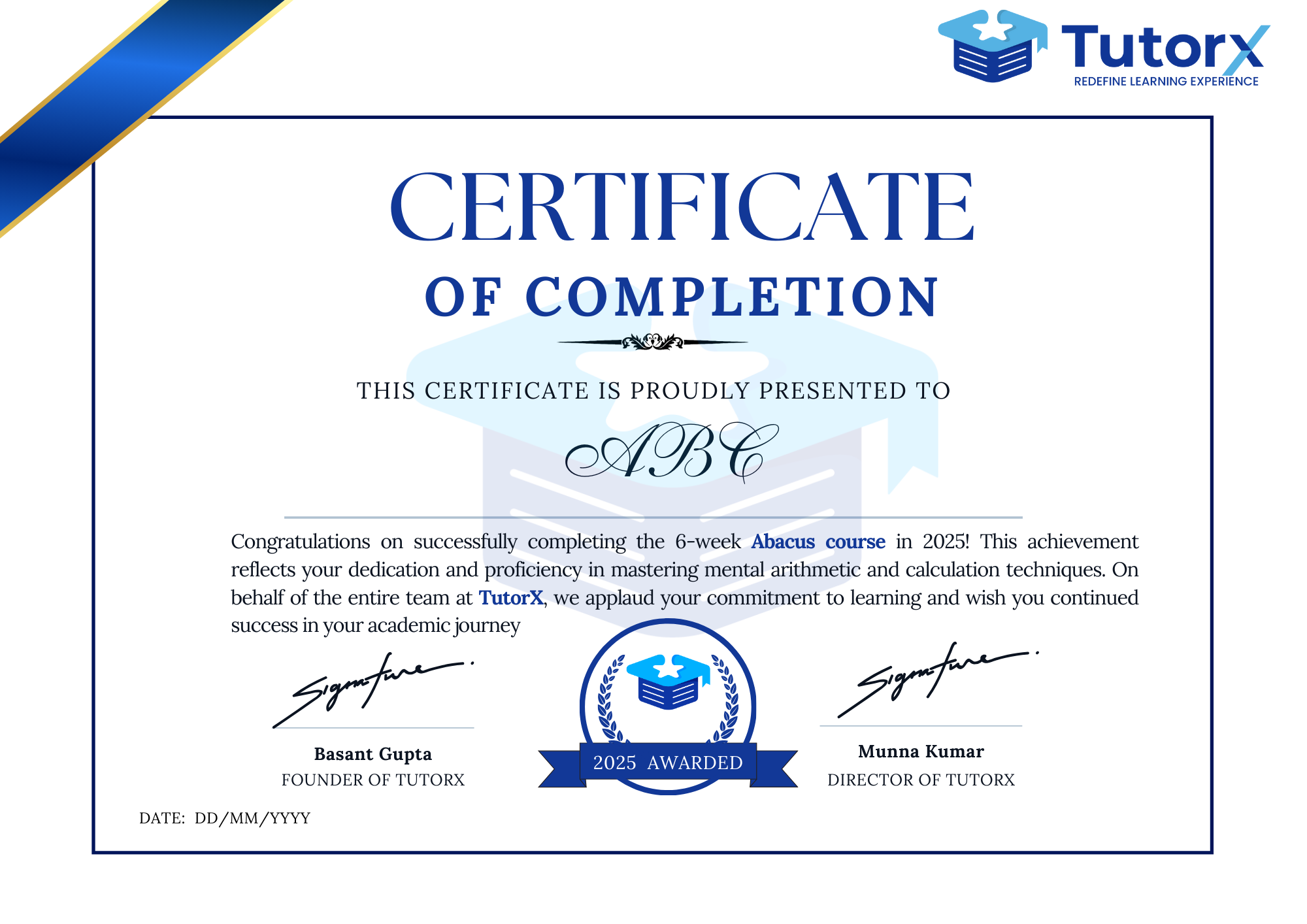
Enhance your expertise and career prospects with a certified Abacus qualification, showcasing your mastery in mental arithmetic and rapid calculations.
Gain in-depth understanding of Abacus techniques, improving speed, accuracy, and cognitive skills for efficient problem-solving.
Learn at your own pace with online Abacus certification programs, designed to fit seamlessly into your schedule.
Reach out to us for inquiries, support, or more information about our personalized tutoring services
We are happy to hear from you. You can either fill out the form or send us an email.
A1, 220, 4th Floor, Sushant Lok Phase 2, Sector 55, Gurugram, Haryana – 122011, India
info@thetutorx.com
